Power strips with USB: What types of USB ports are available, and which is the best choice?

Power strips with USB have become standard equipment in modern workplaces. Whether it’s a smartphone, tablet, headset, or laptop, an increasing number of devices require charging ports. But is a power strip with USB-C worth it? Is USB-A still sufficient? And what charging power is actually needed? In this guide, you will learn about the different types of USB ports, what to look for when buying, and which solution is best suited for the home office, corporate office, or conference room.
Smartphones, tablets, smartwatches, Bluetooth headphones, and many other devices are charged via USB today. At the same time, the number of electronic devices in households, offices, and work environments is steadily rising. This drives the growing need for practical, space-saving power supply solutions. A power strip with USB offers numerous advantages in this regard. Mobile devices can be charged directly via integrated USB ports, eliminating the need for additional power adapters. This leaves more standard outlets available for other electrical devices and results in a much tidier workspace.
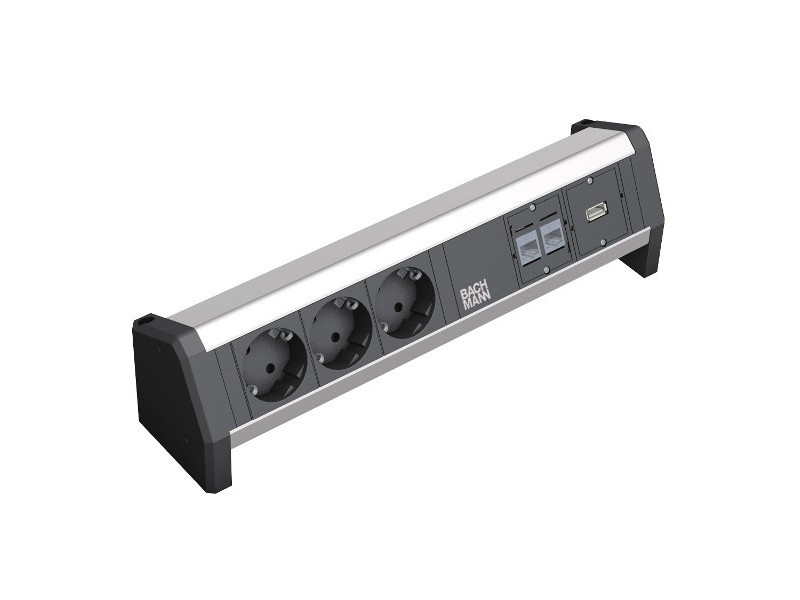
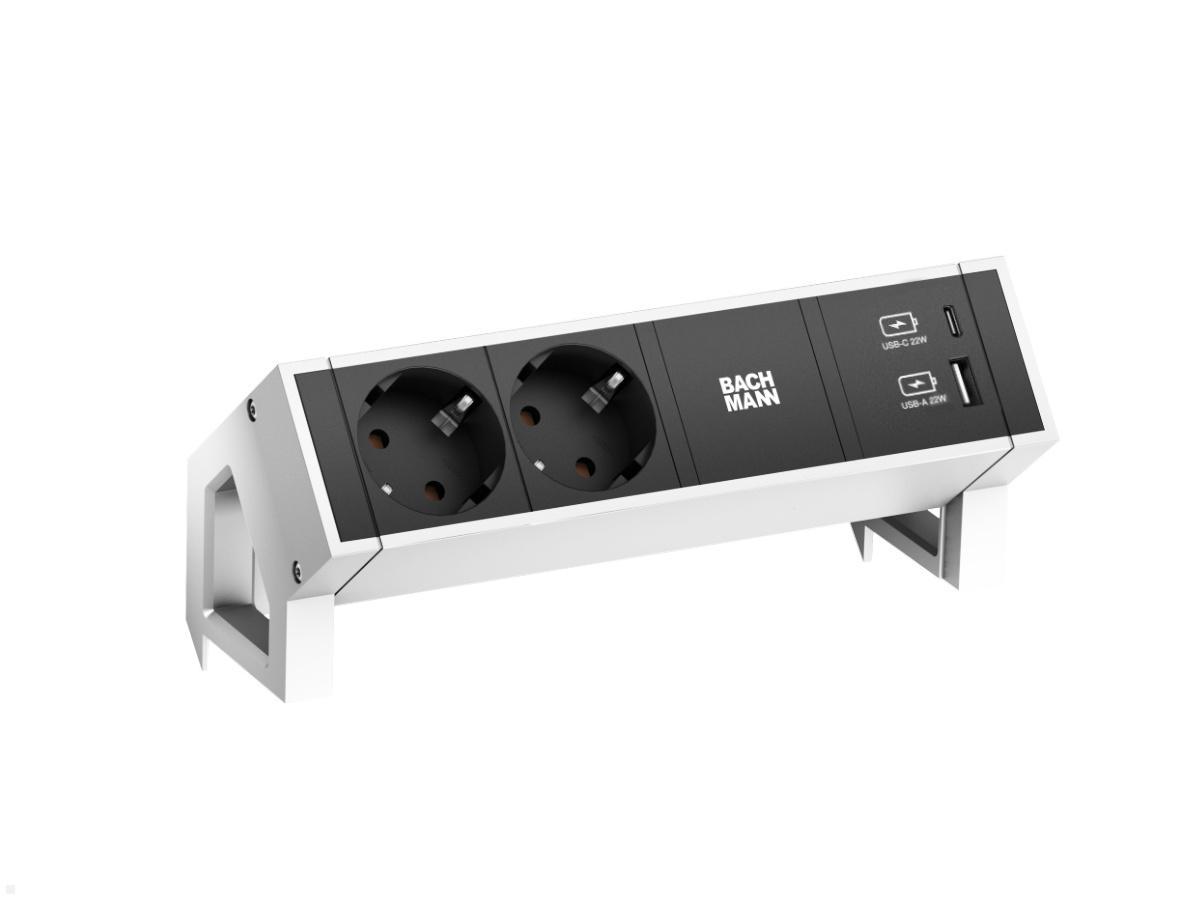
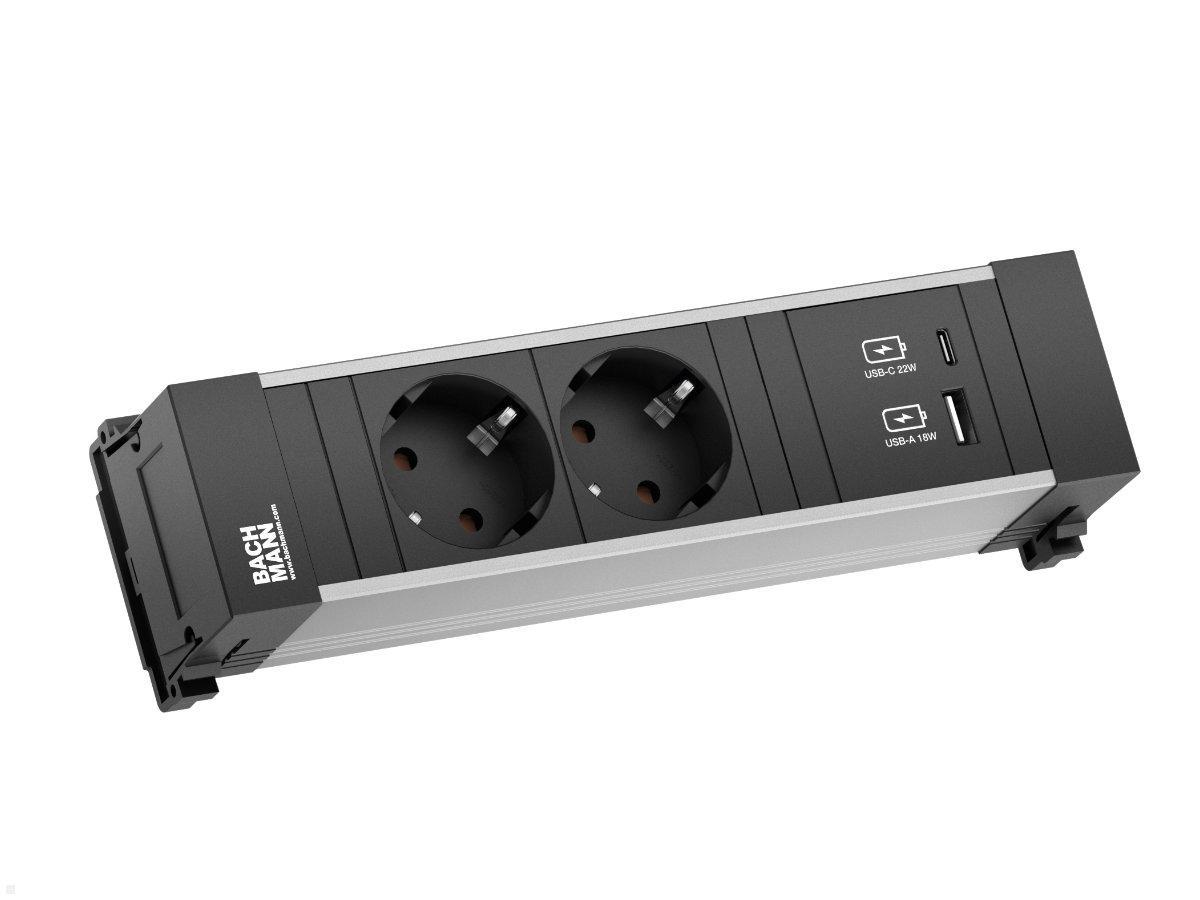
Professional power supply solutions are increasingly being used in offices, home offices, and meeting rooms. Manufacturers like BACHMANN offer various product series that combine standard power outlets with modern USB-A and USB-C charging ports. Examples include the BACHMANN DESK 1 & DESK 2 series for desks, the BACHMANN CONI series for conference rooms, and custom-configurable solutions using BACHMANN Custom Modules.
Why are power strips with USB in such high demand today?
Daily life is becoming increasingly digital. While in the past, one might only have needed to charge a single mobile phone, many people today simultaneously use smartphones, tablets, smartwatches, Bluetooth headphones, laptops, and other electronic devices. Consequently, the number of chargers required is constantly growing. At the same time, the number of available power outlets at many workstations or in living areas is limited. A power strip with USB ports offers a solution here, as mobile devices can be charged directly via integrated USB connections.
This significantly reduces the number of power adapters required. It also creates a much tidier workspace, as fewer chargers and cables are needed. USB ports have become standard equipment, particularly in modern offices and home office setups. Today, users expect the ability to charge mobile devices quickly and conveniently right at their workstation.
What types of USB ports are found on power strips with USB?
When looking at power strips with USB, you will primarily encounter two types of connections: USB-A and USB-C. Both variants are used to charge electronic devices but differ significantly in terms of power output, speed, and future-proofing.
What is USB-A?
USB-A is the classic USB connector that served as the standard for many years. Its rectangular design is still found on numerous chargers, computers, and electronic devices today.
Although modern devices are increasingly adopting USB-C, USB-A remains widespread. Many existing smartphones, power banks, Bluetooth headphones, and cameras are still charged using USB-A cables.
USB-A therefore remains relevant for users of older devices. However, the connector is increasingly reaching its technical limits, as modern devices require ever-higher charging power.
What is USB-C?
USB-C is the modern successor to USB-A and has established itself as the new standard within just a few years. The connector is characterized by its compact design and high performance.
A major advantage is that the plug can be inserted regardless of orientation. Furthermore, USB-C supports modern fast-charging standards and significantly higher charging power. Virtually all modern smartphones, tablets, and many laptops now feature a USB-C port. The European Union has also adopted USB-C as the universal charging standard for numerous devices, a move that will further drive its adoption in the coming years.
As USB-C is now considered a modern standard, many BACHMANN workplace solutions are increasingly being equipped with USB-C ports. The BACHMANN DESK 2 series, in particular, is available in various configurations featuring USB-C charging ports and high-performance USB chargers.
USB-A vs. USB-C: Key differences at a glance
| Feature | USB-A | USB-C |
| Prevalence | Very high | Rapidly growing |
| Orientation | One-way | Reversible |
| Charging power | Limited | Significantly higher |
| Fast charging | Partial | Fully supported |
| Future-proofing | Moderate | Very high |
USB-C is now considered the superior choice for new devices and future applications. Anyone seeking maximal compatibility is required, one should opt for a power strip featuring both USB-A and USB-C ports.
Which USB port is most commonly used today?
When looking at the devices currently in use worldwide, USB-A remains one of the most common connection types. This is because the standard has been in use for many years and is still found in millions of devices. However, the picture changes when it comes to new purchases. Modern smartphones, tablets, and laptops now rely almost exclusively on USB-C. Consequently, USB-C is increasingly becoming the primary connection standard for mobile devices.
Therefore, anyone buying a power strip with USB ports today should ideally choose models that incorporate both USB-A and USB-C. This allows existing devices to remain in use while also meeting future requirements.
Frequently Asked Questions About Power Strips with USB Ports
- What is the difference between USB-A and USB-C?
Although both ports are used to charge devices, they differ significantly in several respects. While USB-A continues to offer broad compatibility, USB-C excels in terms of charging speed, power output, and future-proofing. - Do USB-C power strips charge faster than USB-A models?
In most cases, the answer is a clear yes. USB-C was specifically developed to support higher data transfer rates and charging power. This allows modern devices to charge much faster than they would via traditional USB-A ports. This difference is particularly noticeable with smartphones and tablets; users benefit from shorter charging times and more efficient power delivery. Therefore, anyone who regularly uses multiple mobile devices or prefers fast charging times should opt for a power strip with USB-C. - What does USB Power Delivery (PD) mean?
The term USB Power Delivery (PD) often comes up in the context of USB-C. It refers to a modern fast-charging standard specifically designed for higher power output. USB Power Delivery makes it possible to automatically adjust the charging power to suit the connected device. This allows a smartphone to be powered differently than, for example, a notebook or tablet. USB Power Delivery is playing an increasingly important role, particularly in modern workplaces. Many current notebooks can be charged via USB-C, eliminating the need for separate power adapters. Consequently, numerous BACHMANN solutions now feature high-performance USB-C chargers capable of reliably powering smartphones, tablets, and notebooks alike. - What charging power should a power strip with USB ports offer?
The required charging power depends largely on the devices being charged. Smaller devices such as smartwatches or Bluetooth headphones require relatively little energy. Smartphones, on the other hand, benefit from charging outputs between 18 and 30 watts. Tablets and larger devices often require higher power levels. Anyone wishing to charge modern notebooks or high-performance business laptops directly via USB-C should look for charging outputs of at least 45 to 65 watts. The higher the available power, the more versatile the power strip becomes. - Which devices can be charged using a power strip with USB ports?
Modern power strips with USB ports are suitable for far more devices than many users realize. In addition to smartphones and tablets, devices such as smartwatches, Bluetooth headphones, power banks, e-readers, portable speakers, and cameras can be charged directly via USB. High-performance USB-C ports can even power many notebooks and laptops directly. Modern workplace solutions like BACHMANN DESK 2, or custom-configured connection panels featuring BACHMANN Custom Modules, allow multiple different devices to be powered simultaneously. Depending on the configuration, smartphones, tablets, headsets, or even notebooks can be charged directly via integrated USB ports. - Can notebooks be charged using a power strip with USB ports?
Many current notebooks support charging via USB-C. However, this requires the power strip to provide sufficient power and support USB Power Delivery. This is a convenient way to power business notebooks and modern premium laptops in particular. However, before purchasing, you should check the charging power required by the specific device. - Which is better: a power strip with USB-A or USB-C?
USB-C offers the most advantages for modern devices. The port enables higher charging power, supports fast-charging standards, and is used by almost all current devices. Nevertheless, many users still own devices with USB-A cables. That is why a combination of both port types is often the best solution. A power strip featuring both USB-A and USB-C ensures that both older and modern devices can be powered without issues can be used. At the same time, the workstation remains future-proof for upcoming generations of devices. - Do USB power strips consume power in standby mode?
Like almost any electronic device, power strips with integrated USB ports require a small amount of energy during standby operation. However, with high-quality products, this consumption is very low and is negligible in daily use. Modern electronics operate much more efficiently today than they did just a few years ago. - Are USB power strips energy-efficient?
Modern USB power strips generally operate very efficiently. Since multiple devices can be charged via a single central unit, the number of individual chargers and power adapters is often reduced. In addition to the practical benefits, this often creates a tidier and more convenient workspace. - Are USB power strips safe?
High-quality power strips feature various protective mechanisms designed to safeguard both connected devices and users. These include, for example, overload protection, short-circuit protection, child safety features, and surge protection. A high-quality solution with appropriate safety features is particularly recommended for sensitive electronics such as computers, monitors, or network equipment. - How many USB ports should a power strip have?
The optimal number depends on the specific area of application. - How many USB ports make sense for the home?
For most households, two to four USB ports are sufficient. This allows smartphones, tablets, and other mobile devices to be charged without issue. - How many USB ports are needed for a home office?
Multiple devices are often used simultaneously in a home office. Therefore, four or more USB ports are frequently the better choice. - How many USB ports are suitable for meeting rooms?
Different types of devices are often used in conference rooms. Consequently, solutions that provide both USB-A and USB-C ports are ideal. The BACHMANN CONI series was developed for this type of application. These connection units are integrated directly into the tabletop and can be fitted with USB, network, and multimedia ports in addition to standard power sockets. This creates a professional yet space-saving solution for modern conference rooms. - Which power strip with USB is suitable for a home office?
In a home office, devices such as smartphones, laptops, tablets, and headsets often need to be powered simultaneously. A power strip featuring both USB-A and USB-C ports offers the greatest flexibility for this purpose. Solutions like the BACHMANN DESK 2 series are particularly popular. This unit attaches directly to the desk, providing convenient access to power sockets and USB charging ports. This allows all devices to be powered centrally while keeping the workspace tidy and organized. - Do I need special charging cables for USB-C?
Yes. To take full advantage of USB-C capabilities, a compatible USB-C cable is required. The quality of the cable is particularly important when using fast-charging functions and USB Power Delivery. High-quality cables ensure reliable transmission of maximum charging power. - How long does a power strip with USB ports last?
Its lifespan depends largely on build quality and operating conditions. High-quality power strips feature robust housings and durable electronic components. By choosing quality products and staying within maximum load limits, you can generally rely on your power strip for many years. - Which Bachmann series are available with USB ports?
BACHMANN offers various product series that can be equipped with USB-A and USB-C ports. The BACHMANN DESK 2 series is particularly well-suited for standard office and home office workstations. It combines power sockets and USB charging ports in a compact unit and is mounted directly onto the desk. The BACHMANN CONI and Bachmann POWER FRAME series were developed for meeting rooms and conference tables. These units are integrated into the tabletop to save space and can be equipped with USB, network, and multimedia ports in addition to standard power sockets. Furthermore, BACHMANN Custom Modules allow for the individual configuration of connection panels. This enables USB-A, USB-C, data, and multimedia ports to be flexibly adapted to specific requirements. - What should you look for when buying a power strip with USB?
When purchasing a power strip with USB, you should not focus solely on the number of sockets. It is far more important to consider which devices will be connected in the future and the charging power required for them. While USB-A remains relevant for many existing devices is required, USB-C is increasingly becoming the standard for modern electronics. A combination of both connection types therefore offers the greatest flexibility. In addition, factors such as USB Power Delivery, surge protection, cable length, build quality, and the number of available ports should be taken into account. For those looking to equip a permanent workstation, the BACHMANN DESK 2 series offers a particularly flexible solution. The BACHMANN CONI series is ideal for meeting rooms, while specific individual requirements can be met using BACHMANN Custom Modules. This allows for the selection of a power supply solution that reliably meets both current and future needs while making the workday more convenient.