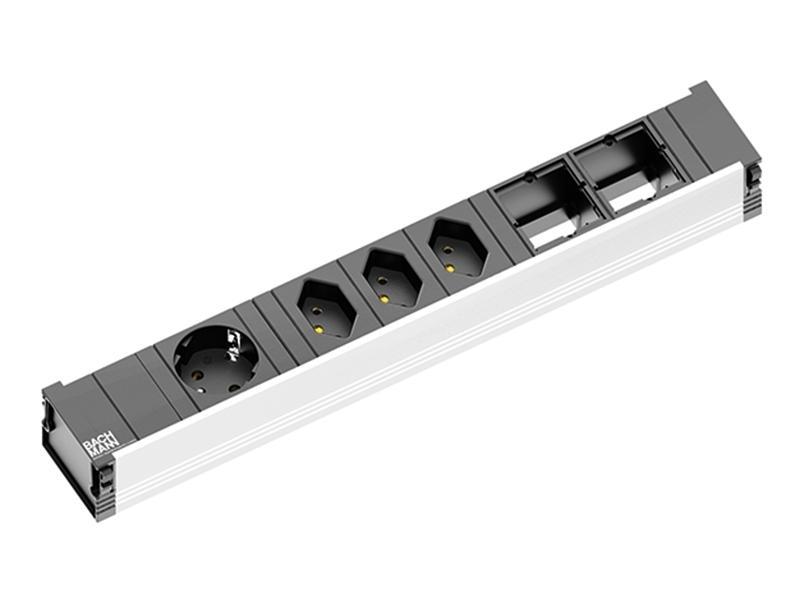
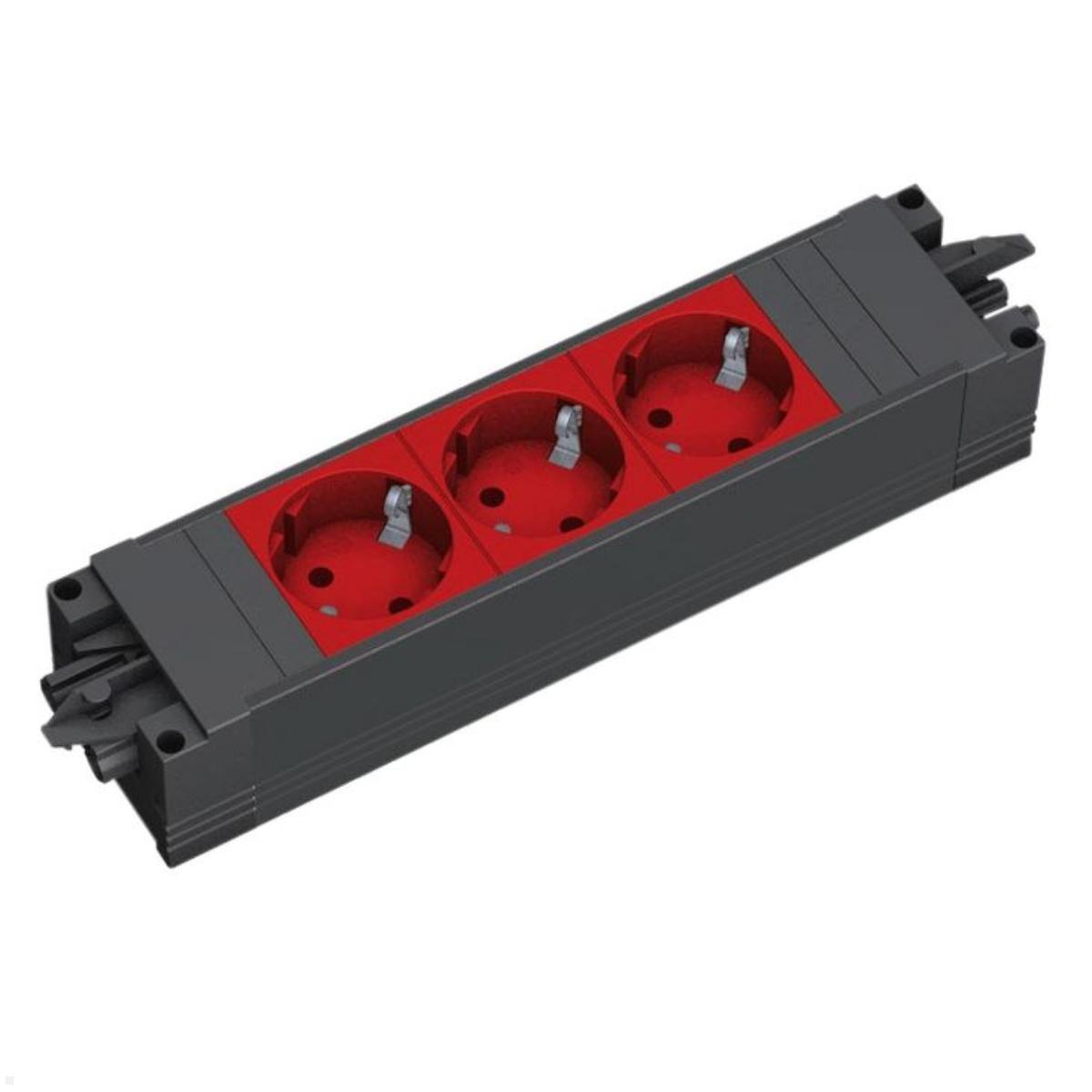
BACHMANN Implements New DIN VDE 0620-2-1 Socket Standard

Safety, reliability and consistently high load capacity are key priorities when it comes to sockets and plug connections. The requirements of DIN VDE 0620-2-1 further develop the technical specifications for plugs and sockets for household and similar applications. Among other aspects, temperature behavior, resistance to ageing and the load capacity of the components used play an important role.
BACHMANN responded to these requirements at an early stage and has further developed its CEE 7/3 products from a technical perspective. Many BACHMANN CEE 7/3 sockets manufactured from January 1, 2026 onwards already meet the corresponding requirements. This not only ensures a high level of product safety but also provides greater planning certainty for future projects and applications.
What Does DIN VDE 0620-2-1 Mean for Sockets?
DIN VDE 0620-2-1 covers plugs and sockets for household and similar applications. It defines technical and safety-related requirements that plugs and socket-outlets must meet. Among other things, the standard applies to plugs and socket-outlets for alternating current, with or without protective contacts, within the specified rated voltages and rated currents. In addition to traditional household applications, this also covers numerous comparable areas of use.
The requirements are not limited to electrical functionality alone. They also consider how plugs and sockets behave under different mechanical, electrical and thermal loads. DIN VDE 0620-2-1:2021-02 introduced changes and extensions compared with the previous version, including requirements relating to resistance to ageing, temperature rise, mechanical loads, crimp connections and other safety-related properties. For manufacturers, this means continuously adapting products and individual components to current technical requirements.
Why Are the Requirements for Sockets Being Further Developed?
Sockets are among those components of an electrical installation that often go largely unnoticed in everyday life. At the same time, they must function reliably for many years. A plug is inserted, removed again and may be subjected to high electrical loads over extended periods. Inside the socket, contacts and connection elements must continue to operate reliably throughout this process. This is precisely where modern testing requirements come into play. They are not only intended to determine whether a socket functions correctly when new. How the product performs during long-term use and under defined loads is equally important.
Relevant areas include:
- Temperature development and thermal load capacity
- Resistance to ageing as well as mechanical and electrical stress
- Contact and connection technology
The current standard includes, among other things, tests for resistance to ageing under mechanical loads as well as revised requirements for temperature rise. These are supplemented by temperature cycle and insertion cycle tests for certain designs. This places an even greater focus on the long-term safety of plug-and-socket connections.
Why Is Temperature Behavior Important?
Electrical contacts can heat up during operation. The extent of this temperature increase depends on factors such as the electrical load, contact resistance and the design of the contact points. Reliable temperature management is therefore an important aspect of product safety.
The requirements regarding temperature rise have been comprehensively revised within DIN VDE 0620-2-1. Temperature cycle tests are also specified for certain connection technologies. For manufacturers, this means that contact components, materials and connection technologies, for example, must be designed accordingly.
How Does BACHMANN Implement the Requirements of the Standard?
BACHMANN has further developed its CEE 7/3 products in several technical areas. The aim of these modifications is to meet the increased requirements for safety, thermal load capacity and long-term reliability. Rather than focusing on just one component, various aspects of the socket design have been optimized.
These include improvements to the design of the contact components and thermal behavior. Safety-relevant components as well as connection technology have also been further developed. Another key focus is increased thermal load capacity. The combination of these design measures enables the sockets to better meet the increased requirements associated with thermal and electrical loads.
What Has Been Optimized in BACHMANN CEE 7/3 Sockets?
The further development covers several areas that collectively contribute to the safety and reliability of the socket.
- Contact components
The contact components form the electrical connection between the plug and socket. Their design is therefore particularly important. BACHMANN has further optimized this area to support reliable contact over the long term. - Thermal behavior
Another key focus is temperature management. The design has been further developed in terms of its thermal behavior to ensure that the sockets can operate reliably even under corresponding loads. - Safety-relevant components
Individual safety-relevant components have also been adapted to meet the increased requirements. BACHMANN therefore considers not only the electrical connection itself, but the socket as an overall system. - Connection technology
The quality of the internal connections also influences the long-term reliability of a product. For this reason, the connection technology has also been further developed.
DIN VDE 0620-2-1 includes, for example, detailed requirements for crimp connections as well as tests relating to their thermal load.
What Does Increased Thermal Load Capacity Mean in Practice?
Increased thermal load capacity is particularly relevant wherever electrical devices are operated for extended periods or sockets are regularly subjected to higher loads. This is by no means limited to traditional household applications. CEE 7/3 sockets can also be found in power strips and power distribution solutions for offices, conference rooms, workplaces, educational institutions and numerous professional applications. In these environments in particular, power distribution solutions are often used for many hours every day. A design that takes temperature development and continuous loads into account helps ensure that electrical connections continue to function reliably even during long-term use.
Which BACHMANN Products Meet the Requirements?
BACHMANN integrated the technical modifications into its product development and manufacturing processes at an early stage. Many selected CEE 7/3 products manufactured from January 1, 2026 onwards already meet the corresponding requirements. The production date is therefore relevant for customers. Depending on the product and manufacturing date, different technical versions may be in circulation. BACHMANN's active implementation of DIN VDE 0620-2-1 is also reflected in current manufacturer documentation. For example, in a current EU Declaration of Conformity for the BN3000 Gen2, BACHMANN lists DIN VDE 0620-2-1:2021 + A1:2023 and DIN VDE 0620-1:2021 for Type F sockets (CEE 7/3) among the applied technical standards and specifications.
What Are the Benefits for Planners and Companies?
Implementing the requirements at an early stage primarily makes long-term project planning easier. When equipping offices, conference rooms, public facilities or other commercial environments, power distribution solutions are often intended to remain in use for many years. It is therefore important to consider future technical requirements at the planning stage. The early adaptation of the BACHMANN product range offers several advantages. Planners and companies can use products whose design already takes increased requirements into account. At the same time, long-term product range and project planning becomes easier. This can be particularly relevant for larger projects in which power distribution solutions are specified, procured or reordered over extended periods.
Enhanced Safety Through the Standard Upgrade Project
The further development of CEE 7/3 products at BACHMANN was not regarded merely as a formal adaptation to normative requirements. As part of the standard upgrade project, various technical aspects of the products were reviewed and optimized. This has further improved the safety level of the affected products. The combination of optimized contact components, improved temperature management, adapted safety-relevant components and further developed connection technology makes a particular contribution. BACHMANN is therefore using the new requirements as a basis for more comprehensive technical development of its sockets.
What Does CEE 7/3 Actually Mean?
The designation CEE 7/3 refers to the Type F protective contact socket commonly used in Germany and numerous other European countries. It features protective contacts on the sides and is designed for corresponding protective contact plugs. In everyday use, this design is commonly referred to as a Schuko socket. CEE 7/3 sockets are also a key component of many professional power distribution solutions. BACHMANN uses CEE 7/3 sockets in numerous power distribution solutions as well.
Where Are CEE 7/3 Sockets Used?
CEE 7/3 sockets are not only found in private households. They are also an integral part of numerous professional power distribution solutions, for example:
- in offices, conference rooms and workplaces
- in educational institutions, hotels and public buildings
- in power strips, desk connection panels and power distribution systems
Why Is the Standard Also Relevant for Professional Applications?
The title of DIN VDE 0620-2-1 refers to plugs and sockets for household and similar applications. Its scope therefore extends well beyond a conventional socket in a private home. Sockets can be subject to intensive use, particularly in professional environments. At workplaces, for example, computers, monitors, power supplies and other devices are continuously supplied with power.
In meeting rooms, displays, video conferencing systems and mobile devices are also used. Power distribution solutions in educational institutions, hotels and public buildings are likewise used regularly and sometimes for extended periods. Reliable contact, controlled temperature development and high mechanical load capacity are therefore key quality characteristics in these environments as well.
What Does the New Standard Mean for Future BACHMANN Projects?
For planners, specialist retailers, companies and users, early technical adaptation provides one key benefit: greater orientation and planning certainty. Anyone planning new workplaces, conference rooms or other professional power distribution solutions today should consider more than just current equipment requirements. Long-term use and future technical requirements also play an important role. With its further developed CEE 7/3 sockets, BACHMANN provides a suitable basis for this.
Many BACHMANN CEE 7/3 products manufactured since January 1, 2026 already take the corresponding normative requirements into account. At the same time, the technical improvements implemented as part of the standard upgrade project have contributed to further enhancing product safety. For users, this means a combination of proven power distribution technology, increased thermal load capacity and a design focused on long-term safety and reliability.
Rather than waiting for future requirements to take effect, BACHMANN integrates them into product development and manufacturing at an early stage – providing additional security for long-term product range and project planning.
Related products